The worst riding day I ever had started with a boot that was half a size too big. My foot slid forward on the peg, I caught the shifter at the wrong angle, and by the time I got home from Bakersfield to Tehachapi my ankle was sore and my confidence was shot. That was years ago, and it taught me the rule I still use every time I shop for gear: fit comes before style, before brand, before everything. This guide walks through how I pick riding boots that fit, step by step, using the Harley-Davidson Eda as the example I know best.
I have ridden for about 22 years, most of them on my Harley-Davidson Heritage Softail, and I have made every boot mistake you can make. I have bought too narrow, too tall, too stiff, and once, memorably, too small because the salesperson said they would stretch. They did not stretch. So if you are shopping for your first pair of real riding boots, or replacing a pair that never quite worked, this is the process I wish someone had walked me through back then.
Start with a boot that fits, and the rest gets easier
The Harley-Davidson Eda is the boot I reach for on weekend rides and long highway days. See today's price and current sizing on Amazon.
Amazon Check Today's Price on Amazon →Step 1: Measure your feet the right way, at the right time
Feet change. Mine are not the same size they were when I bought my first pair of boots, and yours probably are not either. The right time to measure is the end of the day, after you have been on your feet a while, because that is when your feet are at their largest. Stand on a piece of paper, trace both feet, and measure from the back of the heel to the tip of the longest toe. Do both feet, because most people have one foot slightly larger than the other, and always fit the larger one.
When I measured for the Harley-Davidson Eda, I did it in the evening after a long day of errands. I also put on the same weight of sock I planned to ride in, not the thin dress socks I wear to work. That one detail changes the fit more than people expect. If you ride in thick socks and measure in thin ones, the boot will feel perfect in the store and tight on the bike. I learned that the hard way with a pair of touring boots I ordered online years ago. They measured fine in thin socks, and the first time I wore them with riding socks on a 300-mile day, my toes went numb by lunch.
Write the numbers down. You will need them for every pair of boots you ever look at, and you will forget them by next season. I keep mine in the notes app on my phone, and I still check them before I order anything. My left foot measures a half size longer than my right, so I order for the left and let the right sit a touch looser. That is normal, and it is better than squeezing the bigger foot to make the smaller one feel perfect. When I ordered the Eda, I went with my left-foot size and the right boot fits fine with a slightly thicker sock on cold mornings.
Step 2: Understand how the boot is supposed to fit, not just what size you wear
A riding boot should fit differently from a dress shoe. Your heel should sit snugly at the back, with no lift when you walk. Your toes should have a little room to wiggle, about a thumb's width from the end, because your feet swell on long rides and your toes need blood flow to stay warm and responsive on the controls. The widest part of your foot should line up with the widest part of the boot, not be squeezed by it.
The Harley-Davidson Eda is a mid-calf boot with a low heel, and that low heel is part of why it fits so many riders well. A heel that is too high tilts your foot forward and changes where your foot sits on the peg. A heel that is too low can make the arch feel unsupported. The Eda sits in the middle, which is what I want for everyday street riding and longer trips. On my Heritage Softail, the peg position is fairly forward, so a boot with a tall heel would push my toe down toward the shifter and make the reach awkward. The low heel keeps my foot flat and my toe where I expect it.
Pay attention to the ankle. The boot should hug your ankle without cutting off circulation, and you should be able to flex your foot easily to reach the brake and shifter. If you have to fight the boot to move your foot, it is too stiff or too small, and no amount of break-in will fix that. I learned this the hard way with a pair of tall lace-up boots that looked great in the store. The leather was so stiff I could barely pivot my foot between the brake and the peg, and I sold them after two rides. The Eda's zipper and lower shaft make that pivot much easier, which is why I kept reaching for them on group rides.
Step 3: Try them on with your riding gear, and walk around like you mean it
Never try on riding boots in bare feet, and never try them on sitting down and call it done. Put on the socks you will ride in, and if you wear riding jeans with a thicker cuff, wear those too. The cuff changes how the boot feels around the calf, and a boot that fits with thin pants can feel tight with jeans tucked in. I wear my usual riding jeans with a mid-weight cuff, and I tuck them into the boot the way I do on the bike, because that is the actual condition the boot has to work in.
Walk around the store or your living room for a good ten minutes. Go up and down stairs if you can. Squat down like you are picking something up off the ground. Wiggle your toes. Flex your ankle. Do a little heel lift. The boot needs to feel secure through all of that, not just when you are standing still. I also check the toe box when I squat, because that is the moment a too-short boot announces itself.
When I got my Eda boots, I wore them around the house for a few evenings before the first ride. I made dinner in them, ran errands in them, and sat on the couch in them. That sounds silly, but it is the fastest way to find out where a boot pinches before you are 200 miles from home. I also practiced reaching for the brake and shifter while sitting on the bike in the garage, because a boot can feel fine on the floor and different once your knee is bent and your foot is reaching forward. That garage test caught a hot spot on my right heel before it ever became a blister.

Step 4: Check the protection and the sole, because fit is about safety too
A boot that fits well but offers no protection is just a comfortable shoe. Look for a boot that covers the ankle, has a sturdy sole with some grip, and is made of leather or another durable material. If you want certified crash protection, look for a CE rating for motorcycle use; the Eda is a casual riding boot without one. The Harley-Davidson Eda covers the ankle with a mid-calf shaft, and the sole has the kind of tread that grips a peg and a parking lot equally well.
Check the toe box and the heel. You want a boot that gives your toes some structure, not a soft sneaker that would crush if the bike landed on your foot. And check how the sole grips on a slick gas station floor. A boot that slides on a greasy gas station pad is a boot that will put you on the ground before you even get moving. I have a friend who went down in a parking lot on a pair of smooth-soled fashion boots, and she still talks about it. The sole is not the glamorous part of a boot, but it is the part that keeps you upright.
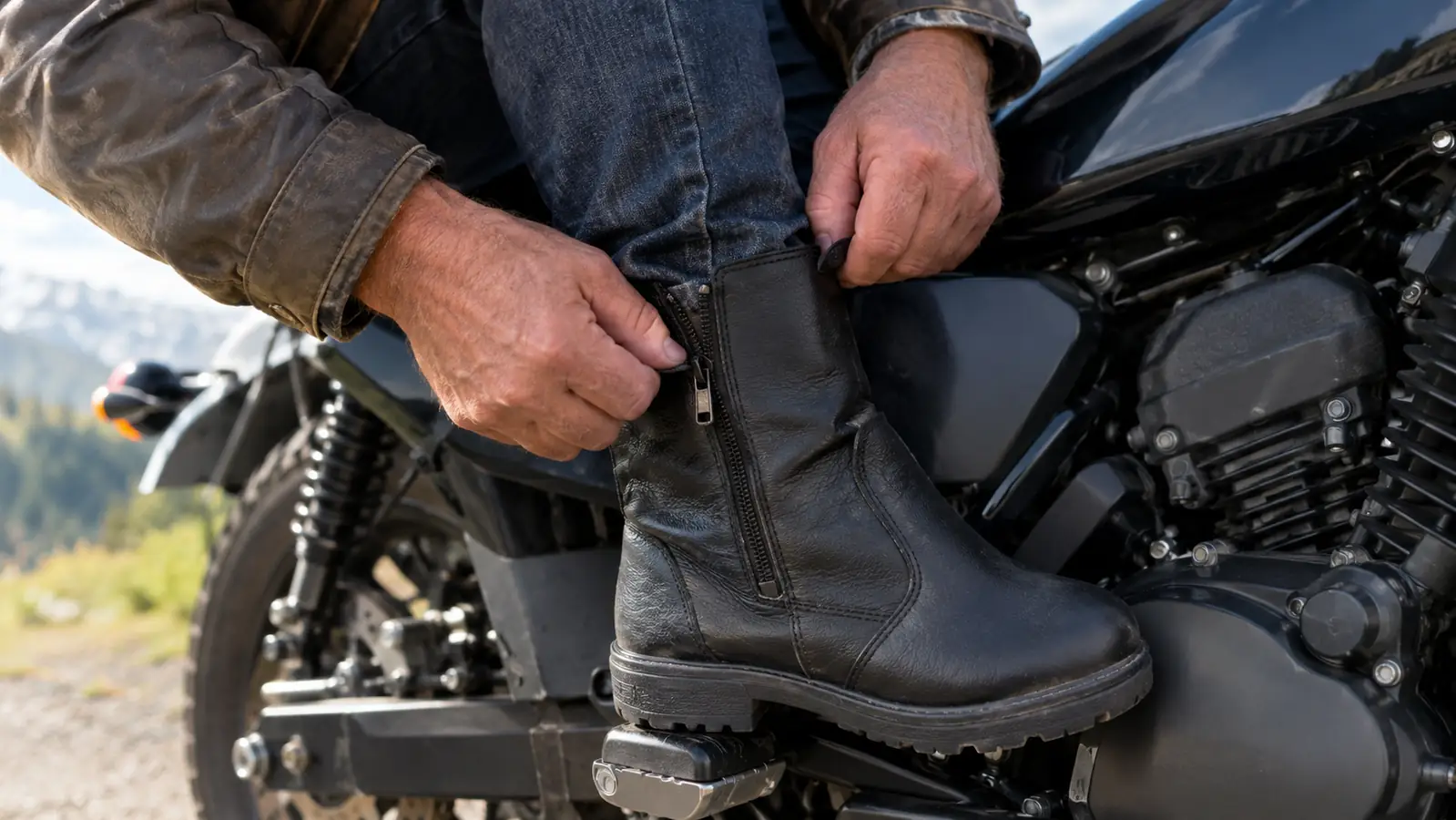
The zipper matters more than you think. A full-length zipper makes the boot easy to get on and off, which means you will actually wear it. The Eda has a zipper with a flap over it, and that flap is not just for looks. It keeps the zipper from digging into your leg and helps keep wind and water out on the highway. On a cold morning ride up to the Kern River, I was glad for that flap. The wind was cutting across the valley and my legs stayed warmer than they would have in a boot with an exposed zipper. I have also had the zipper catch on a pair of cheaper boots, and once you are on the side of the road fighting a stuck zipper, you understand why the flap and the pull matter.
Step 5: Plan the break-in, and know the difference between snug and wrong
Leather boots break in. They soften, they mold to your foot, and they get more comfortable over the first few hundred miles. But there is a difference between snug and wrong. Snug means the boot is firm against your foot with no painful pressure points. Wrong means a specific spot hurts, your toes are jammed, or your heel lifts when you walk. Wrong does not get better with time.
My break-in routine is simple. I wear new boots around the house for a few days, then on short rides, then on a longer ride once they feel broken in. I also carry a spare pair of socks on the first long ride, because a boot that felt fine in the morning can feel different after four hours of heat and vibration. On the first long trip I took in the Eda boots, a three-day loop through the Sierra foothills, I stopped at a gas station outside Porterville and swapped to the thinner socks I had packed. That one change made the last two hours comfortable. By the second day of that trip, the leather had softened enough that I stopped thinking about the boots entirely, which is exactly what you want.
If a boot is painful in the first week, do not assume it will fix itself. I have made that mistake, and I ended up with a pair of boots I never wore again. A good boot should feel like a firm handshake, not a squeeze. Give it a fair chance, wear it around the house and on a couple of short rides, but if a specific spot still hurts after that, trust the pain and send them back. The return window is there for a reason, and a boot that hurts on day one will still hurt on day ninety.
What Else Helps
A few things make any boot fit better and last longer. Good socks matter as much as the boot. I ride in wool or synthetic riding socks, not cotton, because cotton holds moisture and gives me blisters on long days. A boot tree or just stuffing the boots with newspaper when they are wet helps them keep their shape. And if you ride in the heat like I do, in the Central Valley summer, look for a boot with some ventilation or at least a breathable lining. The Harley-Davidson Eda is comfortable for me on hot days, but everyone's feet are different, so pay attention to how yours feel. I also keep a thin pair of insoles on hand, because swapping insoles is the cheapest way to fine-tune a fit that is almost right.
A good boot should feel like a firm handshake, not a squeeze. If it hurts in the first week, it will not fix itself.
Find your size in the Harley-Davidson Eda
The Eda is the boot I reach for on weekend rides and long highway days. Check today's price and current sizing on Amazon.
Amazon Check Today's Price on Amazon →